South Carolina Golf Cart Laws
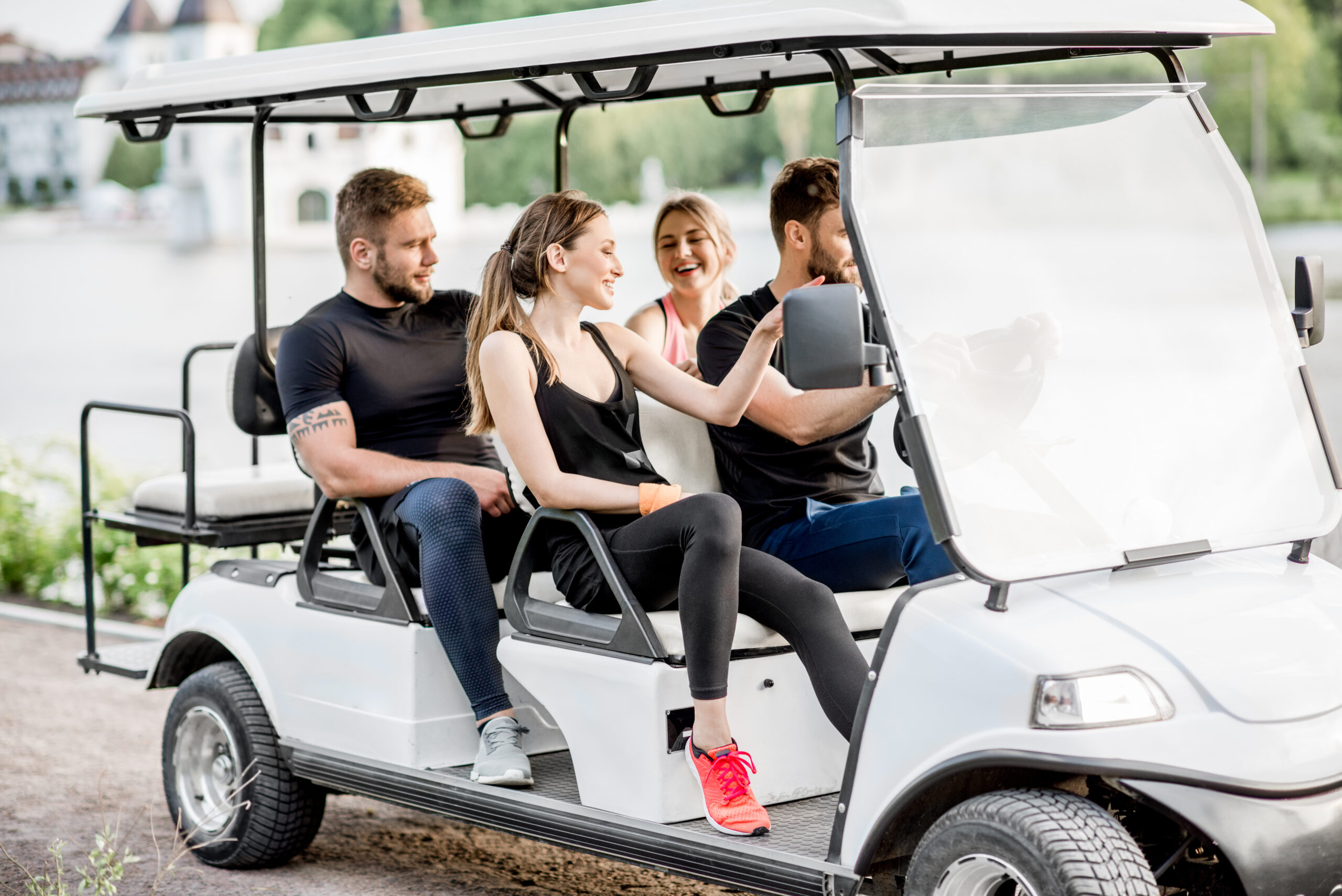 If you’ve spent time in South Carolina, whether you live near a golf course, have visited the barrier islands, or have been to a college football game, you’ve probably noticed golf carts being driven on the road. Whether you’re considering purchasing a golf cart for personal use, renting a golf cart on your next family vacation, or using a golf cart for business purposes, you should learn how to comply with state and local laws.
To legally drive a golf cart on a public road, the golf cart must be insured, permitted, and registered with the DMV. The cost for registration and a permit is five dollars. A golf cart permit must be renewed every five years or at the time the permit holder changes his address. S.C. Code Ann. § 56-2-105. For more information on the registration process, visit the SC DMV’s website here.
Although children are sometimes seen driving golf carts, South Carolina law requires the operator of a golf cart to be at least sixteen years of age with a valid driver’s license. The operator must have in their possession their driver’s license, certificate of registration, and proof of liability insurance for the golf cart.
Also, for the most part, people are only allowed to drive golf carts during daylight hours. An exception exists where counties or municipalities can designate portions of a barrier island to allow people to operate golf carts at night, but only if the golf cart is equipped with working headlights and rear lights. Beaufort County did this when they enacted Ordinance 2017-11, allowing people on Daufuskie Island to drive golf carts at night.
Golf carts may only be operated on secondary highways or streets with a posted speed limit of thirty-five miles per hour or less. Additionally, golf carts may only be operated either within four miles of the registration holder’s address, within four miles of a point of ingress and egress to a gated community, or on any street or secondary highway on an island not accessible by a bridge designed for automobile use. However, a political subdivision may reduce this distance from four miles to no less than two miles. Furthermore, drivers are allowed to cross a highway or street at an intersection where the highway has a posted speed limit above thirty-five miles per hour.
Interestingly, while people may be able to legally possess beer or wine in an open container while on a golf course, they may be in violation of South Carolina law if they cross a public highway driving between holes. Under the law, a person who possesses beer or wine in an open container in a motor vehicle of any kind while “located upon the public highways or highway rights of way of this State” is guilty of a misdemeanor. S.C. Code Ann. § 61-4-110.
Furthermore, golf cart operators may be charged with a DUI, as a motor vehicle is defined as “every vehicle which is self-propelled.” S.C. Code Ann. § 56-1-10. Even if a person is operating a golf cart on private property, such as on a golf course, that person may be charged with a DUI. The Supreme Court of South Carolina elaborated on this subject, holding the statute criminalizing drunk driving “is not limited to public highways but applies anywhere within our State boundaries.” State v. Allen, 314 S.C. 539, 540, 431 S.E.2d 563, 564 (1993).
Due to a golf cart’s inability to travel at high speeds, many people consider golf carts a safe mode of transportation. Today, golf carts are not required to have the life-saving technologies that people expect in other vehicles. However, in response to golf cart-related deaths in South Carolina, the law regulating golf carts may soon require they be equipped with seatbelts at each designated seating position. See H.R. 4147, 124th Gen. Assemb., Reg. Sess. (S.C. 2021). Under HB 4147, golf cart operators and passengers not wearing seat belts when the golf cart is traveling upon a public street or highway can be fined $25. Notably, the language appears to exempt travel on golf courses. To avoid such a fine, golf cart owners would need to install Type 1 or Type 2 seat belt assemblies conforming to 49 C.F.R. 571.209. The cost of installation may depend on your area, but an internet search shows most 4-pack seatbelt assemblies advertised for under $100.
Although a $25 fine may seem insignificant, the enactment of this bill would likely impose civil liability upon the owner of a golf cart in the event someone is injured and the owner negligently failed to install adequate seatbelts. Biggers v. Bald Head Island is a North Carolina Court of Appeals case where a six-year-old child died after falling from a rented golf cart driven by the child’s parent while on vacation in the Village of Bald Head Island. Biggers v. Bald Head Island, 200 N.C. App. 83, 88, 682 S.E.2d 423, 426 (2009). The parents attempted to recover damages from the resort and the golf cart owner under a negligence theory, alleging they breached a duty of care by renting a golf cart without seatbelts and by failing to provide a warning of the purportedly hidden danger of falling out of a golf cart. The North Carolina Court of Appeals affirmed the trial court’s decision to grant summary judgment to the defendants, reasoning that there was no affirmative duty for defendants to alter a commonly manufactured product, such as a golf cart. Id. at, 89, 682 S.E.2d at 427.
If HB 4147 is passed, an owner’s failure to equip a golf cart with seatbelts could trigger negligence per se in the event of an injury like the one in Biggers. Negligence per se is negligence arising from a defendant’s violation of a statute. Trivelas v. S.C. DOT, 348 S.C. 125, 134, 558 S.E.2d 271, 275 (Ct. App. 2001). Under negligence per se, when a defendant‘s violation of a statute results in an injury to a person, there is a presumption that the violation is the proximate cause of the injury. Myers v. Evans, 225 S.C. 80, 87, 81 S.E.2d 32, 35 (1954). However, a defendant may rebut the theory if explanatory or excusatory circumstances existed. Trivelas, 348 S.C. at 133, 558 S.E.2d at 275 (Ct. App. 2001). In any event, a person who owns a golf cart should be cognizant of the laws that they must obey.
To help comply with the law, a golf cart owner/operator should:
- Keep a map on the golf cart which shows a four-mile boundary.
- Avoid roads with speed limits over 35 mph.
- Refrain from driving a golf cart while intoxicated.
- Renew their registration every 5 years or when their address changes.
- Possess their driver’s license, certificate of registration, and proof of liability insurance for the golf cart.
- Check their local laws for any updates to the four-mile radius or whether the golf cart can be driven at night.
Contributor: Justin Lawlor.

About Henry D. McMaster, Jr.
Special Counsel
Henry McMaster, Jr. is an associate in the Retail & Hospitality practice group. Read Henry's Biography